



Pipelining Processors for Decomposing Character Animation
March 2026
What is the paper about?
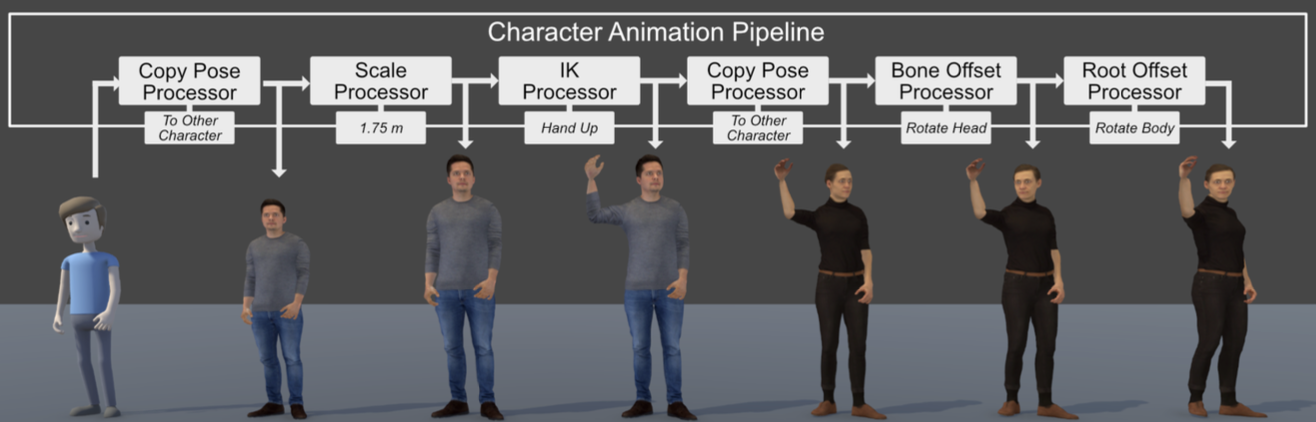
The paper presents a modular pipeline architecture designed for animating humanoid characters (HCs) in virtual environments. It breaks down the animation process into individual processors such as copying motion data, scaling characters, or applying inverse kinematics (IK). This modular pipeline makes it easier to customize, fine-tune, and reuse animations, especially in real-time environments. The implementation is open-source and intended for use in platforms like Unity (a popular Game Engine), enabling a scalable, reusable solution for realistic character animation.
The proposed pipeline:
- Modularity: Combining input from different motion sources (like body trackers or AI).
- Flexibility: Enables easy reordering, parameterization, and extension of processors.
- Realistic Animations: Supports IK and precise body part control to handle challenges like partial tracking or misaligned skeletal data.
- Open Source: The reference implementation is freely available as Unity packages, encouraging broader adoption and customization.
What are the results?
The authors created an open-source system in Unity that:
- Breaks down complex character animation into manageable steps.
- Lets users rearrange or duplicate steps easily to meet different needs.
- Supports real-time animations with better control and fewer unwanted effects.
What are possible fields of application?
- Social VR: Enhancing realistic movement in avatars for virtual social interactions.
- XR Training and Simulations: Supporting applications in fields like healthcare, military, or industrial training by providing accurate avatar representation.
- Rehabilitation and Therapy: Improving motion retargeting and tracking for VR-based physical therapy programs.
- Gaming: Creating life-like and customizable avatars for immersive gameplay.
How does the research in the paper contribute to shaping the metaverse?
The research contributes to the metaverse by providing tools for creating realistic, flexible, and dynamic virtual characters that can adapt to diverse use cases. As avatars are central to user identity in the metaverse, the ability to personalize and animate them accurately enhances immersion and engagement. The modular pipeline also supports scalability, making it easier for developers to create varied and high-quality animations, which are essential for a diverse and inclusive metaverse experience.
Reference
Merz, C., Tschanter, J., Kern, F., Lugrin, J.-L., Wienrich, C. & Latoschik, M. E. 2024. Pipelining Processors for Decomposing Character Animation. In Proceedings of the 30th ACM Symposium on Virtual Reality Software and Technology (VRST ‘24). Association for Computing Machinery, New York, NY, USA, Article 62, 1–2. https://doi.org/10.1145/3641825.3689533