



Manipulating Immersion: The Impact of Perceptual Incongruence on Perceived Plausibility in VR
March 2026
What is the paper about?
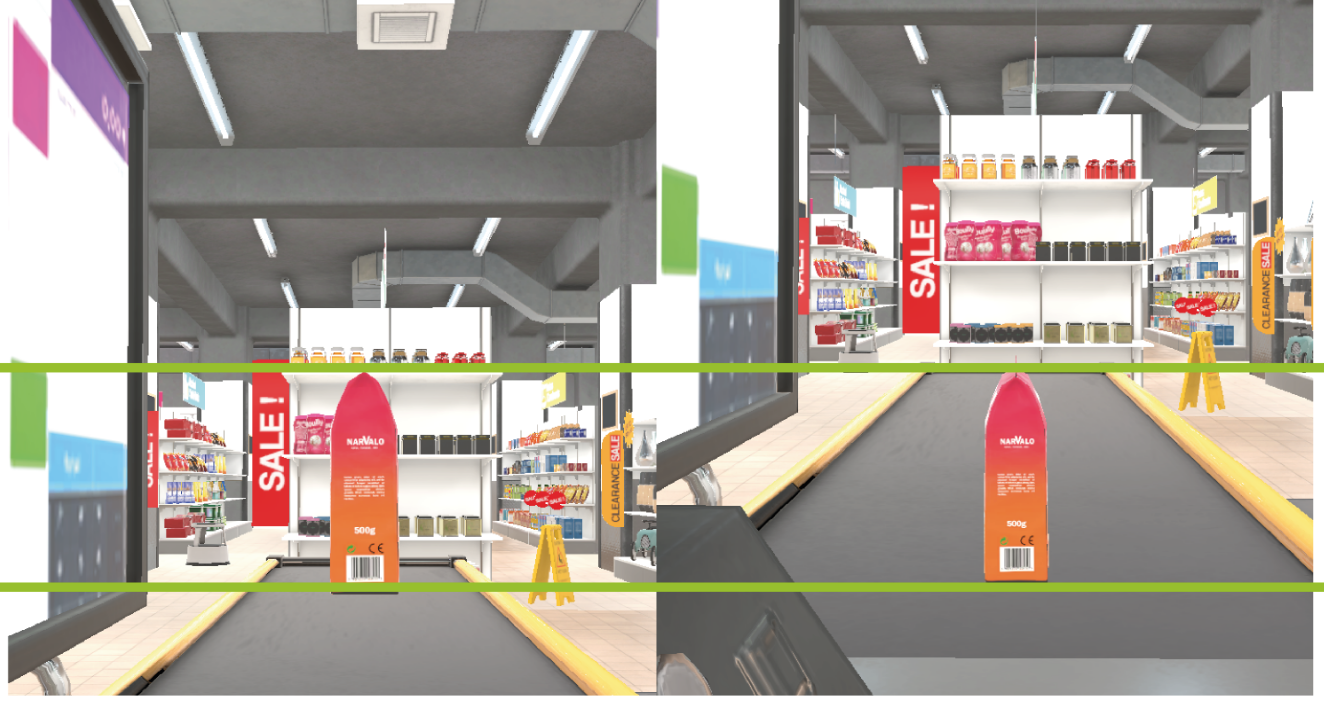
The paper investigates how incongruencies in virtual reality (VR) environments—on both cognitive and perceptual levels—affect users’ perceptions of plausibility, presence, and spatial presence. Using a virtual supermarket scenario, the researchers manipulated the size of familiar objects (cognitive incongruency) and VR tracking settings (perceptual incongruency) to assess how these factors influence immersion and user experience. The study was grounded in the Congruence and Plausibility (CaP) model, which proposes that various incongruencies impact plausibility, a critical factor for an immersive XR experience.
What are the results?
- Plausibility: Both cognitive manipulations (familiar size of objects) and perceptual manipulations (tracking changes) significantly reduced perceived plausibility. For example, altering object sizes to defy real-world expectations reduced the believability of the virtual environment.
- Presence: Incongruencies lowered participants’ sense of being “present” in the VR environment. Manipulated object sizes and limited tracking quality both had a significant impact.
- Spatial Presence: Only perceptual manipulations (like restricted head tracking) affected spatial presence. Cognitive manipulations (e.g., object size changes) had no notable impact on spatial presence, supporting the CaP model’s layered approach to congruencies.
- User Experience: Conditions with severe tracking restrictions caused increased workload, VR sickness, and reduced immersion. However, these factors did not directly alter plausibility or presence perceptions.
What are possible fields of application?
- VR Training Simulations: Insights into how cognitive and perceptual cues affect plausibility can improve VR training for fields like healthcare, aviation, or emergency response, where realism and immersion are vital.
- Entertainment and Gaming: Understanding plausibility can help developers create more engaging and believable VR experiences while avoiding discomfort from perceptual mismatches.
- Psychological Research and Therapy: Manipulating immersion and plausibility could be used to study cognitive processes or as a therapeutic tool for mental health treatments.
- Education: Enhancing educational VR applications by refining congruency mechanisms to maximize focus and reduce cognitive dissonance.
How does the research in the paper contribute to shaping the metaverse?
The research provides critical insights into how congruencies and immersion influence user experiences in extended reality (XR). As the metaverse aims to integrate virtual and physical realities seamlessly, ensuring plausibility and immersion becomes essential for creating believable and engaging environments. The study validates the CaP model, offering a framework for developers to balance cognitive and perceptual cues. This could lead to more realistic, immersive metaverse experiences where users feel truly present, enhancing both usability and enjoyment.
Reference
Brübach, L., Röhm, M., Westermeier, F., Latoschik, M. E., & Wienrich, C. (2024). Manipulating Immersion: The Impact of Perceptual Incongruence on Perceived Plausibility in VR. 2024 IEEE International Symposium on Mixed and Augmented Reality (ISMAR), 1078–1086. https://doi.org/10.1109/ISMAR62088.2024.00124