
Does Task Matter? Task-Dependent Effects of Cross-Device Collaboration on Social Presence
March 2026
What is the paper about?
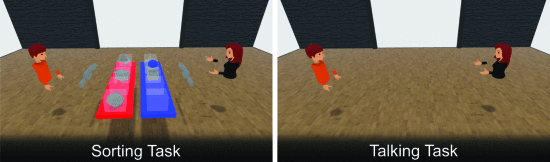
The authors investigate whether the type of task (a sorting task vs. a talking task) changes how cross-device / asymmetric collaboration (VR–VR symmetric vs. VR–desktop asymmetric) affects users’ experience in social XR. The authors compared three device configurations (VR–VR, VR–desktop, desktop–VR) on self-perception, other-perception, and task perceptions.
What are the results?
- Task moderates device asymmetry effects. Differences in social presence caused by asymmetric devices (VR vs. desktop) were stronger during the sorting task but largely diminished or disappeared during the talking task — i.e., for plain conversation, asymmetric setups can be on par with symmetric VR–VR.
- Spatial presence, ownership, and agency higher in VR and for sorting. Spatial presence and the sense of embodiment (ownership, agency) showed main effects of Immersion (VR–VR > desktop cases) and Task (sorting > talking). Post-hoc tests confirmed higher presence/agency/ownership for VR–VR compared to the desktop condition.
- Social presence / psychobehavioral engagement shows interaction. Psychobehavioral engagement (other) revealed a significant Immersion × Task interaction: Talking increased other-engagement for desktop–VR and VR–desktop relative to sorting, while VR–VR scored higher during sorting.
- No consistent co-presence or plausibility differences. Co-presence measures and virtual-human plausibility subscales showed no robust effects across conditions. Humanness was rated higher in talking than sorting.
- Task load & enjoyment: Sorting harder, talking easier/more enjoyable. Sorting was rated as significantly more mentally/physically demanding, more frustrating, and requiring more effort; Talking had higher usability and enjoyment ratings. Crucially, asymmetry did not significantly change perceived task load — collaboration remained feasible across devices.
What are possible fields of application?
- Remote collaboration / meetings: systems that allow mixed participation (some users in HMDs, others on regular desktops) — especially for conversational uses (standups, seminars, social spaces) where asymmetry is less harmful.
- Education & training: conversational lectures, discussions or case debriefs can include lower-immersion participants without big social-presence loss; spatial/simulation labs may still benefit from full VR for all participants.
- Hybrid product design / review workflows: choose which activities require full immersion (spatial manipulation) and which can be handled cross-device (brainstorming, reviews).
How does the research in the paper contribute to shaping the metaverse?
- Design rule of thumb: task matters. Platform designers should prioritize matching device affordances to task types — enable cross-device participation by default for conversational/social spaces, but preserve or compensate for immersion gaps when the task demands spatial manipulation.
- Inclusive, device-agnostic social XR: evidence that asymmetric participation can be effective lowers the bar for broader adoption (fewer hardware barriers), informing metaverse strategies that want large, heterogeneous user bases.
- Engineering & UX guidance: when spatial presence, agency, or fine motor interaction are critical, invest in richer tracking / input or adaptive UI; for social talk scenarios, focus on audio quality, conversational UX, and avatar expressivity rather than forcing identical device stacks.
Reference
Merz, C., Wienrich, C., & Latoschik, M. E. (2025). Does Task Matter? Task-Dependent Effects of Cross-Device Collaboration on Social Presence. Proceedings of the IEEE Visualization/VR Workshop. https://doi.org/10.1109%2fVRW66409.2025.00116