


Towards Understanding Harassment in Social Virtual Reality: A Study Design on the Impact of Avatar Self-Similarity
March 2026
Towards Understanding Harassment in Social Virtual Reality: A Study Design on the Impact of Avatar Self-Similarity
What is the paper about?
The paper proposes solutions to investigate harassment in social virtual reality, with a specific focus on how avatar self-similarity influences emotional, physiological, and psychological responses to harassment. To do this, a standardized, realistic harassment scenario and an experimental design were developed aiming to better understand how self-similarity of avatars shapes user experiences.
What are the results?
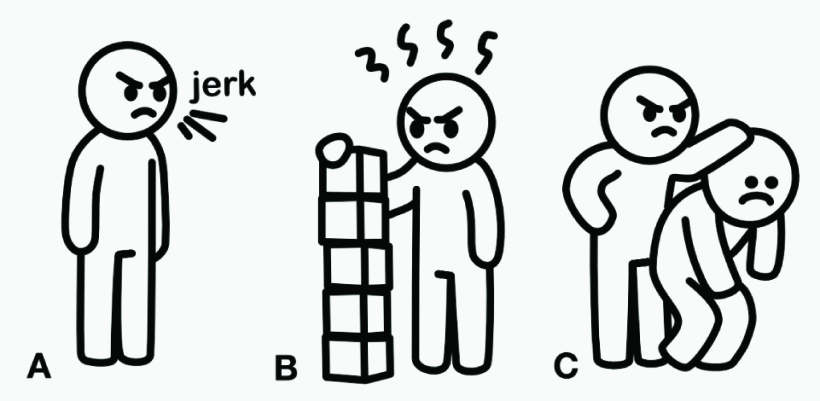
- Realistic Harassment Scenario: A scenario that covers verbal, environmental, and physical harassment to serve as a standardized framework for studies. A Unity application for the scenario was developed based on literature and evolved with VR and bullying prevention experts as well with VR users.
- Study Design: A 2x2 between-subjects design was developed and expected outcomes hypothesized:
- Negative impacts from harassment compared to neutral behavior
- Stronger effects when avatars are highly self-similar
What are possible fields of application?
- Platform Safety & Moderation: The research could aid in designing more effective harassment detection, reporting, and mitigation systems in social VR platforms.
- Mental Health Research: The scenario and study design are a good baseline to advance the understanding of how immersive harassment affects emotional states.
- Policy & Governance of Virtual Worlds: The work can support evidence-based guidelines for ethical XR design and user safety standards.
How does the research in the paper contribute to shaping the metaverse?
By addressing a core challenge, emotional safety in social virtual environments, the research contributes to a safer metaverse. It highlights a potential trade-off between personalization/identity expression and vulnerability in avat-driven metaverse platforms. Further, research material was developed to study this trade-off and guide the creation of safe social spaces in virtual environments.
Reference
Tschanter, J., Merz, C., Wienrich, C., & Latoschik, M. E. (2025). Towards Understanding Harassment in Social Virtual Reality: A Study Design on the Impact of Avatar Self-Similarity. 2025 IEEE Conference on Virtual Reality and 3D User Interfaces Abstracts and Workshops (VRW), 172–177. https://doi.org/10.1109/VRW66409.2025.00043