


Self-Similarity Beats Motor Control in Augmented Reality Body Weight Perception
March 2026
What is the paper about?
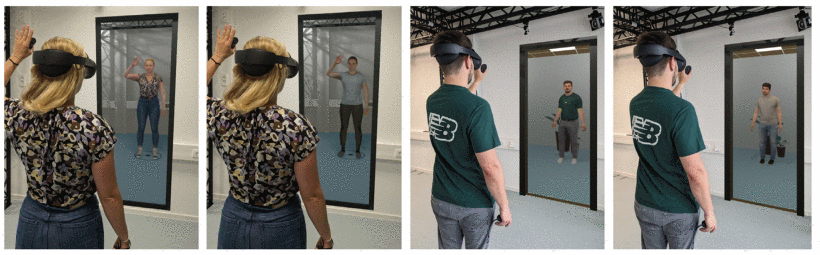
The authors investigate how self-similarity (a photorealistic avatar that looks like the participant vs. a generic avatar) and motor control (avatar movements coupled to the participant vs. independently animated) affect sense of embodiment, self-identification, and body-weight perception in a video see-through Augmented Reality (AR) setup.
What are the results?
- Self-similarity matters most. Self-similar avatars significantly increased virtual body ownership, self-identification, and produced more accurate body-weight estimates compared to generic avatars.
- Motor control effects were weaker in AR. Having visuomotor control increased agency but its downstream effects on self-identification and weight estimation were much smaller than typically reported in VR; motor control did not significantly change weight-estimation accuracy in this AR setup.
- Participant traits predict estimates. Participants’ BMI, self-esteem, and body-shape concerns consistently predicted estimation behavior. Gender differences appeared - women tended to estimate more accurately than men in some measures.
- Interpretation: AR’s mixed-reality constraints (lower immersion, visibility of one’s real body, timing/visual incongruencies) likely reduce the impact of motor control compared to VR, while visual self-similarity remains a robust cue for embodiment and perceptual accuracy.
What are possible fields of application?
- Clinical / therapeutic tools for body-image disorders (AR exposures that use self-similar avatars with adjustable weight while keeping the patient in the real therapy setting).
- Assessment tools for objective and subjective body-image evaluation in research and diagnostics.
- Avatar & UX design for AR/Metaverse apps — informing when to prioritize photoreal personalization vs. behavioral synchrony to drive identification.
- Education / psychoeducation (e.g., demonstrating realistic body changes in a familiar real environment).
How does the research in the paper contribute to shaping the metaverse?
- Design guidance for believable AR avatars: shows that visual self-similarity (photoreal personalization) is highly effective at boosting embodiment and perceptual accuracy even when full motor-control benefits are limited by AR constraints — important for social/therapeutic AR spaces.
- Highlights system-level tradeoffs: demonstrates that device/display characteristics and coherence with the real world (latency, passthrough quality, visibility of the real body) change which avatar features matter — a critical engineering/UX signal for metaverse platforms that mix real and virtual content.
- Personalization & ethics implications: using self-similar, modifiable avatars can improve perceived realism and therapy outcomes, but raises questions about representation (ethnic diversity of generic avatars) and responsible use in social/metaverse services — the paper flags these limits and future directions.
Reference
Fiedler, M. L., Botsch, M., Wienrich, C., & Latoschik, M. E. (2025). Self-Similarity Beats Motor Control in Augmented Reality Body Weight Perception. IEEE Transactions on Visualization and Computer Graphics, 31(5). https://doi.org/10.1109/TVCG.2025.3549851 )